Best CloudHealth Alternatives in 2026: Escaping Broadcom Legacy FinOps Lock-In
Compare top CloudHealth alternatives. Discover why CostGlass flat pricing, 6-hour refresh, and hands-on engineers beat legacy Broadcom contract lock-in.
Enterprise engineering and finance teams migrating away from Broadcom's VMware-bundled CloudHealth require a modern FinOps platform that eliminates predatory annual contract lock-ins, 24-to-48-hour data latency, and passive, unexecuted recommendation backlogs. Modern alternatives like CostGlass offer predictable flat-rate pricing, 6-hour cross-cloud sync, and hands-on senior DevOps engineers who execute cloud savings directly inside your infrastructure to protect operating margins.
The Broadcom CloudHealth Crisis: Why Enterprises are Fleeing Legacy FinOps
Since Broadcom's acquisition of VMware, enterprise customers utilizing CloudHealth (now VMware Tanzu CloudHealth) have faced a series of disruptive changes. From forced enterprise software bundling and opaque pricing restructures to reduced customer support SLAs, the platform once considered a safe default for multi-cloud cost management has turned into an expensive, slow-moving legacy bottleneck.
Legacy FinOps tools like CloudHealth were built over a decade ago for an era of slow, monthly procurement cycles. They suffer from several critical modern architecture gaps:
- Extreme Billing Lag: Data refreshes only once every 24 to 48 hours, meaning massive engineering anomalies or resource leaks can run unchecked for days before triggering alerts.
- Software-Only Recommendations: The platform provides a passive, 200-item backlog of rightsizing recommendations that engineering teams rarely have the time to execute, leading to compound cloud waste.
- Opaque Contract Surcharges: Pricing is typically tied to a percentage of cloud spend (the "cloud tax") or gated behind six-figure annual contract minimums, penalizing your infrastructure scaling.
- Siloed Modern Telemetry: Legacy platforms fail to natively integrate Kubernetes pod-level metrics, Snowflake warehouse credits, and AI token APIs into a single, cohesive ledger without expensive add-on modules.
Evaluating CloudHealth alternatives is no longer just about finding a prettier dashboard—it is a strategic necessity to protect SaaS gross margins and reclaim engineering velocity.
Direct Comparison: CostGlass vs. Broadcom CloudHealth
| Feature | CostGlass | Broadcom CloudHealth | Why It Matters |
|---|---|---|---|
| Pricing Model | Predictable flat monthly fee (0% cloud tax) | Percentage of spend or six-figure annual lock-in | CostGlass keeps 100% of savings in your pocket. |
| Data Refresh Rate | Clean 6-hour refresh across all clouds | 24 to 48-hour billing lag | Immediate anomaly detection prevents budget overruns. |
| Hands-On Execution | Included 8 hours/mo of DevOps execution (Scale plan) | Passive dashboards, zero code contribution | CostGlass engineers write the Terraform to execute savings. |
| SaaS & AI Integrations | Native (OpenAI, Anthropic, Snowflake, Datadog) | Limited / Requires manual custom CSV ingest | Tracks dynamic AI token and data warehouse costs out-of-the-box. |
| Data Residency | UK, EU, US, APAC Regional Cells & Private BYOC | US-centric SaaS hosting only | Essential for GDPR, HIPAA, and strict financial compliance. |
The Financial Math of Modern FinOps: Percentage of Spend vs. Flat Rate
Legacy platforms and MSP resellers of CloudHealth frequently charge between 1% and 3% of your total monthly cloud spend. While this is marketed as "aligned incentives," it acts as a direct tax on your company's growth. If your cloud spend scales from $100,000 to $300,000 per month due to new customer acquisition, your legacy FinOps software bill triples—even if you did not use a single new feature in their dashboard.
CostGlass operates on a transparent, predictable flat-rate pricing model that never penalizes your growth:
- Free: $0/mo (up to £5,000/mo cloud spend cap)
- Starter: $99/mo (up to £15,000/mo cloud spend cap)
- Growth: $499/mo (up to £50,000/mo cloud spend cap)
- Scale: $1,499/mo (up to £100,000/mo cloud spend cap; includes 8 dedicated senior DevOps/FinOps engineer-hours every month to execute approved optimizations)
- Enterprise: Custom pricing (> £100,000/mo cloud spend cap; custom SLA, private BYOC deployment)
By switching from a percentage-of-spend tool to CostGlass, a SaaS enterprise spending $150,000/mo on cloud infrastructure instantly saves over $30,000 annually on software licensing alone, while gaining dedicated engineering execution resources.
The Hidden Cost of "Building It In-House" vs. Buying CostGlass
When confronted with high legacy software costs, many engineering organizations fall into the DIY trap. They task senior platform engineers with building in-house billing pipelines, writing complex Python scripts to parse AWS CUR 2.0 files, and designing custom Grafana dashboards.
This in-house build path is a silent budget killer. Cloud billing schemas are incredibly fragile and change constantly. Maintaining custom ETL pipelines to normalize AWS, Azure, GCP, and Kubernetes costs requires ongoing engineering maintenance, distracting your most expensive team members from shipping revenue-generating product features.
Instead of burning $100,000+ in developer payroll on a fragile internal tool, CostGlass connects natively in 5 minutes. You get a fully normalized, unified multi-cloud ledger updated every 6 hours, virtual tagging, and automated off-hours scheduling out-of-the-box, allowing your engineers to focus on your core product.
How to Configure & Automate Your Migration to CostGlass
Transitioning from CloudHealth to CostGlass is straightforward and requires zero downtime or agent installations:
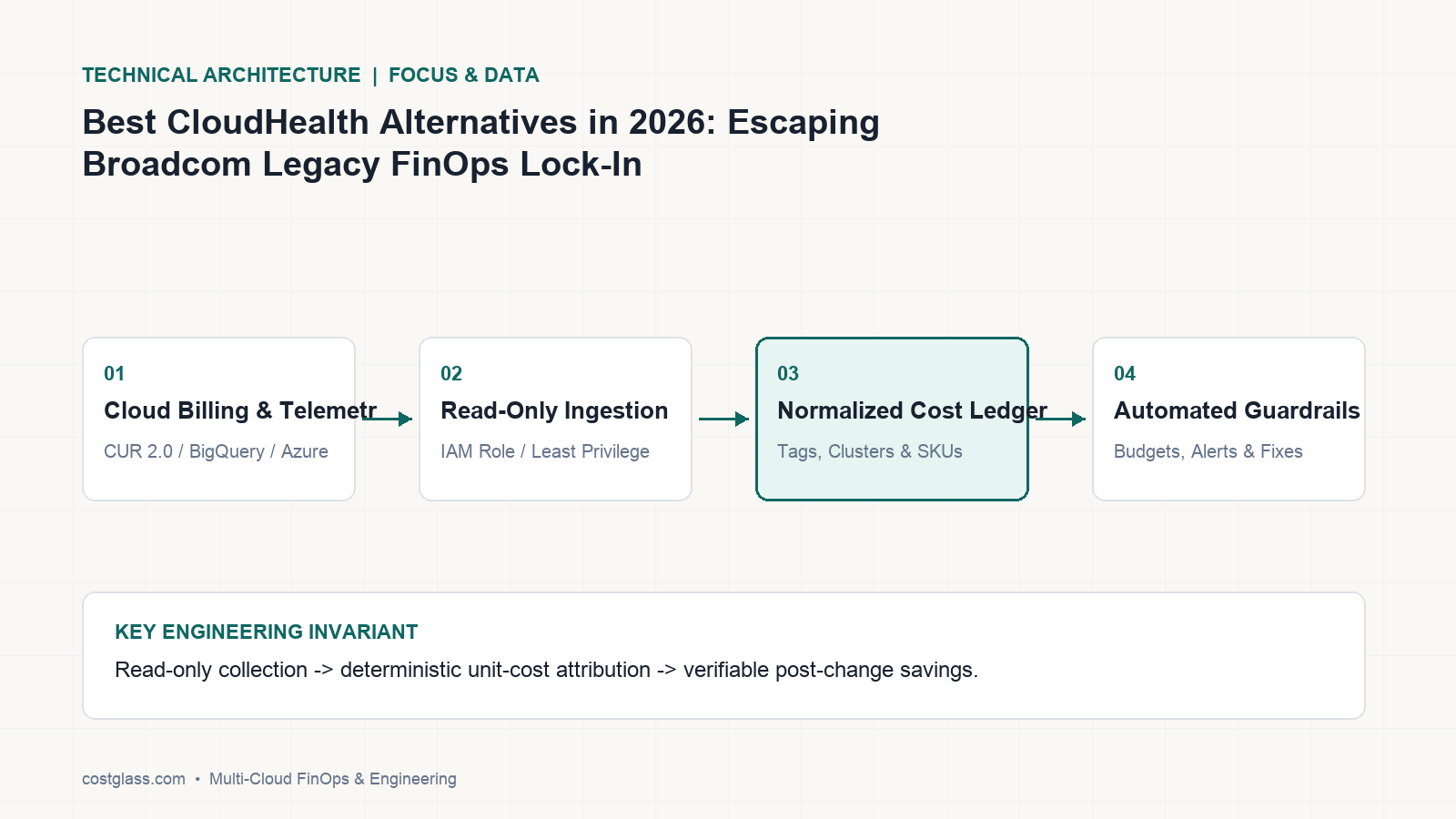
Step 1: Connect Your Cloud Accounts via Least-Privilege IAM
Navigate to the CostGlass console and establish secure, read-only connections to your cloud accounts. For AWS, you can deploy our secure 1-click CloudFormation template or run our custom Terraform generator to establish a read-only role with a unique ExternalId parameter. You can review our detailed AWS connection guide to get started.
Step 2: Deploy Lightweight Kubernetes Cost Tracking
Unlike legacy tools that charge hefty surcharges for container visibility, CostGlass includes native Kubernetes pod and namespace cost allocation. Deploy the lightweight CNCF OpenCost exporter to your EKS, AKS, or GKE clusters to instantly map container CPU, RAM, and GPU resource requests against your real cloud billing ledger.
Step 3: Implement Retroactive Virtual Tagging
One of CloudHealth's biggest pain points is its complex, proprietary tagging abstraction layer. CostGlass simplifies this with Virtual Tagging. You can write simple, logical rules to retroactively group and allocate untagged resources, shared databases, or support fees across business units without mutating live cloud resources or causing Terraform drift.
Step 4: Let CostGlass Engineers Execute Your Savings Backlog
If you are on our Scale or Enterprise plan, you do not need to assign your team to write rightsizing scripts or configure scheduling. Provide our embedded FinOps engineers with access to your staging environment, and we will write the Terraform pull requests to rightsize instances, configure off-hours schedules, and clean up idle resources for you.
Frequently Asked Questions
How long does it take to migrate from CloudHealth to CostGlass?
Most organizations achieve complete multi-cloud visibility within 5 to 15 minutes. Because CostGlass utilizes read-only IAM policies and native API integrations, there are no agents to install or long sync times. Historical data is fully populated and normalized within hours of connection.
Can we run CostGlass inside our own AWS account for compliance?
Yes. For fintech, healthcare, and regulated enterprises requiring strict data sovereignty, CostGlass offers an Enterprise self-hosted Private AWS Deployment (BYOC). You can deploy our entire serverless stack privately within your own VPC so zero billing telemetry or metadata ever leaves your cloud boundary. Read more about our sovereign data residency capabilities.
Does CostGlass charge extra for Kubernetes and Unit Economics?
No. Unlike competitors who charge +25% surcharges for Kubernetes optimization or up to $500/month extra for unit economics, CostGlass includes native container cost allocation, unit economics, and multi-cloud instance scheduling in our standard flat-rate tiers.
Ready to escape legacy contract lock-in and reclaim your engineering budget? Explore our transparent flat-rate pricing or view our detailed CloudHealth comparison to see how CostGlass delivers immediate ROI.
Los equipos empresariales de ingeniería y finanzas que migran fuera de CloudHealth (empaquetado por Broadcom con VMware) necesitan una plataforma moderna de FinOps que elimine los contratos anuales abusivos, la latencia de datos de 24 a 48 horas y los backlogs de recomendaciones pasivas que nunca se ejecutan. Alternativas modernas como CostGlass ofrecen precios predecibles de tarifa plana, sincronización multinube cada 6 horas e ingenieros sénior de DevOps que ejecutan directamente los ahorros en su infraestructura para proteger los márgenes operativos.
La crisis de CloudHealth con Broadcom: por qué las empresas abandonan las herramientas FinOps heredadas
Desde la adquisición de VMware por parte de Broadcom, los clientes empresariales que utilizan CloudHealth (ahora VMware Tanzu CloudHealth) han sufrido una serie de cambios drásticos. Desde el empaquetamiento forzado de software empresarial y reestructuraciones de precios opacas hasta la degradación de los SLA de soporte, la plataforma que antes se consideraba una opción predeterminada y segura para la gestión de costes multinube se ha convertido en un cuello de botella heredado, lento y costoso.
Términos y herramientas de FinOps tradicionales como CloudHealth se crearon hace más de una década para una era de ciclos de adquisición mensuales lentos. Hoy adolecen de varias deficiencias críticas de arquitectura moderna:
- Retraso extremo en la facturación: Los datos solo se actualizan una vez cada 24 a 48 horas, lo que significa que anomalías masivas de ingeniería o fugas de recursos pueden pasar desapercibidas durante días antes de activar una alerta.
- Recomendaciones limitadas a software: La plataforma genera un backlog pasivo de más de 200 sugerencias de rightsizing que los equipos de ingeniería rara vez tienen tiempo de aplicar, lo que genera un desperdicio recurrente en la nube.
- Recargos contractuales opacos: Los precios suelen estar vinculados a un porcentaje del gasto en la nube (el "impuesto a la nube") o condicionados a contratos mínimos anuales de seis cifras, penalizando la escala de su infraestructura.
- Telemetría moderna fragmentada: Las plataformas heredadas no integran de forma nativa métricas a nivel de pod de Kubernetes, créditos de data warehouse de Snowflake ni llamadas a APIs de tokens de IA en un único registro unificado sin costosos módulos adicionales.
Evaluar alternativas a CloudHealth ya no consiste únicamente en buscar un panel de control más intuitivo: es una necesidad estratégica para proteger los márgenes brutos de SaaS y recuperar la agilidad en ingeniería.
Comparativa directa: CostGlass frente a Broadcom CloudHealth
| Característica | CostGlass | Broadcom CloudHealth | Por qué es importante |
|---|---|---|---|
| Modelo de precios | Tarifa mensual plana predecible (0% de impuesto a la nube) | Porcentaje del gasto o bloqueo contractual anual de seis cifras | CostGlass mantiene el 100% de los ahorros en su presupuesto. |
| Frecuencia de actualización | Sincronización limpia cada 6 horas en todas las nubes | Retraso en la facturación de 24 a 48 horas | La detección inmediata de anomalías evita desbordamientos presupuestarios. |
| Ejecución práctica | Incluye 8 horas/mes de ejecución DevOps (plan Scale) | Paneles pasivos, cero contribución de código | Los ingenieros de CostGlass escriben el código de Terraform para aplicar los ahorros. |
| Integraciones SaaS e IA | Nativas (OpenAI, Anthropic, Snowflake, Datadog) | Limitadas / Requieren ingesta manual mediante CSV personalizados | Supervisa de inmediato los costes dinámicos de tokens de IA y almacenes de datos. |
| Residencia de datos | Células regionales en UK, EU, US, APAC y despliegue privado BYOC | Alojamiento SaaS centrado exclusivamente en EE. UU. | Esencial para GDPR, HIPAA y normativas financieras estrictas. |
Las matemáticas financieras del FinOps moderno: porcentaje del gasto frente a tarifa plana
Las plataformas heredadas y los revendedores MSP de CloudHealth cobran habitualmente entre el 1% y el 3% de su gasto mensual total en la nube. Aunque esto se comercialice como "alineación de incentivos", en la práctica actúa como un impuesto directo sobre el crecimiento de su empresa. Si su gasto en la nube escala de $100,000 a $300,000 mensuales gracias a la adquisición de nuevos clientes, su factura de software FinOps tradicional se triplica, incluso si no ha utilizado ni una sola función nueva del panel.
CostGlass opera con un modelo de tarifa plana transparente y predecible que nunca penaliza su crecimiento:
- Free: $0/mes (límite de gasto en la nube de hasta £5,000/mes)
- Starter: $99/mes (límite de gasto en la nube de hasta £15,000/mes)
- Growth: $499/mes (límite de gasto en la nube de hasta £50,000/mes)
- Scale: $1,499/mes (límite de gasto en la nube de hasta £100,000/mes; incluye 8 horas mensuales dedicadas de un ingeniero sénior de DevOps/FinOps para ejecutar optimizaciones aprobadas)
- Enterprise: Precios personalizados (límite de gasto en la nube superior a £100,000/mes; SLA personalizado, despliegue privado BYOC)
Al cambiar de una herramienta basada en porcentaje del gasto a CostGlass, una empresa SaaS con un gasto mensual de $150,000 en infraestructura en la nube ahorra inmediatamente más de $30,000 al año solo en licencias de software, al tiempo que adquiere recursos dedicados de ingeniería para la ejecución de mejoras.
El coste oculto de construir internamente frente a comprar CostGlass
Al enfrentarse a los elevados costes de las plataformas de software tradicionales, muchas organizaciones de ingeniería caen en la trampa del desarrollo interno. Asignan a ingenieros de plataforma sénior la tarea de construir canalizaciones de facturación propias, programar scripts complejos en Python para procesar archivos AWS CUR 2.0 y diseñar paneles personalizados en Grafana.
Esta estrategia de desarrollo interno es un drenaje silencioso de recursos. Los esquemas de facturación en la nube son sumamente frágiles y evolucionan de forma constante. Mantener canalizaciones ETL personalizadas para normalizar costes de AWS, Azure, GCP y Kubernetes requiere un soporte de ingeniería continuo, lo que aparta a sus profesionales mejor pagados del desarrollo de funcionalidades de producto que generan ingresos.
En lugar de consumir más de $100,000 en salarios de desarrollo en una herramienta interna frágil, CostGlass se conecta de forma nativa en 5 minutos. Obtendrá de serie un registro multinube completamente normalizado y unificado que se actualiza cada 6 horas, etiquetado virtual y programación automática de apagado fuera de horario, lo que permite a su equipo centrarse en su producto principal.
Cómo configurar y automatizar su migración a CostGlass
El cambio desde CloudHealth hacia CostGlass es directo y no requiere interrupciones del servicio ni instalación de agentes:
Paso 1: Conecte sus cuentas de nube mediante IAM con privilegios mínimos
Acceda a la consola de CostGlass y configure conexiones seguras de solo lectura con sus cuentas de nube. Para AWS, puede desplegar nuestra plantilla segura de 1 clic en CloudFormation o ejecutar nuestro generador de Terraform para habilitar un rol de solo lectura con un parámetro ExternalId único. Puede revisar nuestra guía de conexión de AWS detallada para comenzar.
Paso 2: Despliegue el seguimiento ligero de costes en Kubernetes
A diferencia de las herramientas heredadas que aplican recargos elevados por la visibilidad de contenedores, CostGlass incluye de forma nativa la asignación de costes a nivel de pod y espacio de nombres en Kubernetes. Despliegue el exportador ligero CNCF OpenCost en sus clústeres de EKS, AKS o GKE para correlacionar al instante las solicitudes de CPU, RAM y GPU de los contenedores con su registro real de facturación en la nube.
Paso 3: Implemente el etiquetado virtual retroactivo
Uno de los mayores inconvenientes de CloudHealth es su capa de abstracción de etiquetado compleja y propietaria. CostGlass simplifica este proceso mediante Virtual Tagging. Puede definir reglas lógicas sencillas para agrupar y asignar de forma retroactiva recursos sin etiquetar, bases de datos compartidas o tarifas de soporte entre unidades de negocio, sin alterar recursos en producción ni provocar desviaciones (drift) en Terraform.
Paso 4: Deje que los ingenieros de CostGlass ejecuten su backlog de ahorros
Si cuenta con nuestro plan Scale o Enterprise, no necesita asignar a su equipo la redacción de scripts de rightsizing ni la configuración de políticas de apagado. Proporcione a nuestros ingenieros integrados de FinOps acceso a su entorno de staging y redactaremos las pull requests de Terraform para optimizar el tamaño de las instancias, programar apagados fuera de horario y eliminar recursos inactivos por usted.
Preguntas frecuentes
¿Cuánto tiempo lleva migrar de CloudHealth a CostGlass?
La mayoría de las organizaciones obtienen visibilidad multinube completa en un plazo de 5 a 15 minutos. Dado que CostGlass utiliza políticas de IAM de solo lectura e integraciones nativas vía API, no es necesario instalar agentes ni esperar sincronizaciones prolongadas. Los datos históricos se procesan y normalizan por completo en cuestión de horas tras la conexión.
¿Podemos ejecutar CostGlass dentro de nuestra propia cuenta de AWS por cumplimiento normativo?
Sí. Para empresas de fintech, salud y sectores regulados que requieren una estricta soberanía de datos, CostGlass ofrece un despliegue privado autohospedado en AWS para clientes Enterprise (BYOC). Puede desplegar toda nuestra arquitectura serverless de forma privada dentro de su propia VPC, garantizando que ningún dato de telemetría de facturación ni metadato salga de su perímetro de nube. Obtenga más información sobre nuestras capacidades de residencia soberana de datos.
¿Aplica CostGlass cargos adicionales por Kubernetes o métricas de Unit Economics?
No. A diferencia de competidores que imponen recargos de más del 25% por la optimización de Kubernetes o hasta $500 mensuales adicionales por métricas de costes unitarios, CostGlass incluye asignación nativa de costes de contenedores, unit economics y programación horaria de instancias multinube en todos nuestros planes estándar de tarifa plana.
¿Listo para librarse del bloqueo contractual heredado y recuperar su presupuesto de ingeniería? Explore nuestros transparentes precios de tarifa plana o consulte nuestra comparativa con CloudHealth detallada para ver cómo CostGlass genera un retorno de inversión inmediato.
Enterprise-Engineering- und Finanzteams, die sich von Broadcoms mit VMware gebündeltem CloudHealth abwenden, suchen nach einer modernen FinOps-Plattform, die räuberische mehrjährige Vertragslaufzeiten, 24- bis 48-stündige Datenlatenz und passive, nie umgesetzte Empfehlungs-Backlogs beseitigt. Moderne Alternativen wie CostGlass bieten planbare Pauschalpreise, plattformübergreifende Synchronisierung alle 6 Stunden und erfahrene DevOps-Ingenieure, die Einsparpotenziale direkt in Ihrer Infrastruktur umsetzen, um Ihre operativen Margen zu sichern.
Die Broadcom-CloudHealth-Krise: Warum Unternehmen Legacy-FinOps verlassen
Seit der Übernahme von VMware durch Broadcom sehen sich Unternehmenskunden von CloudHealth (jetzt VMware Tanzu CloudHealth) mit massiven Umwälzungen konfrontiert. Von erzwungenen Software-Bündelungen und intransparenten Preisumstrukturierungen bis hin zu drastisch reduzierten Support-SLAs: Die Plattform, die einst als verlässlicher Standard für Multi-Cloud-Kostenmanagement galt, hat sich zu einem teuren, trägen Flaschenhals entwickelt.
Legacy-FinOps-Tools wie CloudHealth wurden vor über einem Jahrzehnt für eine Ära langsamer, monatlicher Beschaffungszyklen entwickelt. Sie weisen mehrere kritische Architekturlücken auf:
- Extreme Abrechnungslatenz: Daten werden nur alle 24 bis 48 Stunden aktualisiert. Das bedeutet, dass massive Anomalien oder Ressourcenlecks tagelang unbemerkt bleiben können, bevor Alarme ausgelöst werden.
- Reine Software-Empfehlungen: Die Plattform liefert ein passives Backlog von über 200 Rightsizing-Empfehlungen, für deren Umsetzung Engineering-Teams selten Zeit haben – die Folge ist kumulierte Cloud-Verschwendung.
- Intransparente Vertragszuschläge: Die Preise sind meist an einen Prozentsatz der Cloud-Ausgaben gekoppelt (die sogenannte „Cloud-Steuer“) oder an sechsstellige jährliche Mindestvertragssummen gebunden, was das Skalieren Ihrer Infrastruktur bestraft.
- Isolierte Telemetriedaten: Ältere Plattformen schaffen es oft nicht, Kubernetes-Metriken auf Pod-Ebene, Snowflake-Warehouse-Credits und KI-Token-APIs ohne teure Zusatzmodule nativ in einem zentralen Hauptbuch zusammenzuführen.
Die Evaluierung von CloudHealth-Alternativen ist längst mehr als die Suche nach einem hübscheren Dashboard – sie ist eine strategische Notwendigkeit, um SaaS-Bruttomargen zu schützen und die Entwicklungsgeschwindigkeit wiederherzustellen.
Direkter Vergleich: CostGlass vs. Broadcom CloudHealth
| Funktion | CostGlass | Broadcom CloudHealth | Warum es wichtig ist |
|---|---|---|---|
| Preismodell | Planbare monatliche Flatrate (0% Cloud-Steuer) | Prozentualer Anteil der Ausgaben oder sechsstellige Jahresverträge | Mit CostGlass verbleiben 100 % der Einsparungen bei Ihnen. |
| Datenaktualisierung | Schneller 6-Stunden-Zyklus über alle Clouds hinweg | 24 bis 48 Stunden Latenz bei Abrechnungsdaten | Sofortige Erkennung von Anomalien verhindert Budgetüberschreitungen. |
| Hands-on-Umsetzung | Inklusive 8 Std./Monat DevOps-Umsetzung (Scale-Tarif) | Passive Dashboards, keinerlei Code-Beiträge | CostGlass-Ingenieure schreiben den Terraform-Code zur Umsetzung der Einsparungen. |
| SaaS- & KI-Integrationen | Nativ (OpenAI, Anthropic, Snowflake, Datadog) | Eingeschränkt / Erfordert manuelle CSV-Exporte | Erfasst dynamische Kosten für KI-Tokens und Data Warehouses direkt nach der Einrichtung. |
| Datenresidenz | Regionale Zellen in UK, EU, US, APAC & privates BYOC | Nur US-zentriertes SaaS-Hosting | Essenziell für DSGVO, HIPAA und strikte Compliance-Vorgaben im Finanzsektor. |
Die wirtschaftliche Realität modernen FinOps: Prozentuale Ausgaben vs. Flatrate
Legacy-Plattformen und MSP-Wiederverkäufer von CloudHealth verlangen häufig zwischen 1 % und 3 % Ihrer gesamten monatlichen Cloud-Ausgaben. Obwohl dies gern als „Interessenangleichung“ verkauft wird, wirkt es wie eine direkte Steuer auf das Wachstum Ihres Unternehmens. Wenn Ihre Cloud-Ausgaben durch Kundengewinnung von 100.000 $ auf 300.000 $ pro Monat steigen, verdreifacht sich Ihre FinOps-Software-Rechnung – selbst wenn Sie kein einziges neues Feature im Dashboard genutzt haben.
CostGlass setzt auf ein transparentes, planbares Flatrate-Preismodell, das Skalierung niemals abstraft:
- Free: 0 $/Monat (bis zu 5.000 £/Monat Cloud-Ausgaben)
- Starter: 99 $/Monat (bis zu 15.000 £/Monat Cloud-Ausgaben)
- Growth: 499 $/Monat (bis zu 50.000 £/Monat Cloud-Ausgaben)
- Scale: 1.499 $/Monat (bis zu 100.000 £/Monat Cloud-Ausgaben; enthält jeden Monat 8 Stunden dedizierte Senior DevOps/FinOps-Ingenieurunterstützung zur Umsetzung freigegebener Optimierungen)
- Enterprise: Individuelle Preisgestaltung (> 100.000 £/Monat Cloud-Ausgaben; individuelles SLA, private BYOC-Bereitstellung)
Durch den Wechsel von einem prozentualen Abrechnungsmodell zu CostGlass spart ein SaaS-Unternehmen mit Cloud-Ausgaben von 150.000 $/Monat allein bei den Softwarelizenzen sofort über 30.000 $ pro Jahr – und erhält zusätzlich dedizierte Ingenieurkapazitäten für die praktische Umsetzung.
Die versteckten Kosten von Eigenentwicklungen („Build vs. Buy“)
Angesichts hoher Softwarekosten verfallen viele Engineering-Organisationen dem DIY-Reflex: Sie beauftragen erfahrene Plattform-Ingenieure damit, eigene Abrechnungs-Pipelines zu bauen, komplexe Python-Skripte zum Parsen von AWS CUR 2.0-Dateien zu schreiben und eigene Grafana-Dashboards zu entwerfen.
Dieser Weg ist ein stiller Budgetfresser. Cloud-Abrechnungsschemata sind fragil und ändern sich fortlaufend. Das Warten individueller ETL-Pipelines zur Normalisierung von AWS-, Azure-, GCP- und Kubernetes-Kosten bindet dauerhaft Engineering-Ressourcen und hält Ihre teuersten Entwickler davon ab, umsatzrelevante Produktfeatures auszuliefern.
Anstatt über 100.000 $ an Entwicklergehältern in ein fehleranfälliges internes Tool zu investieren, lässt sich CostGlass innerhalb von 5 Minuten nativ anbinden. Sie erhalten ein vollständig normalisiertes, vereinheitlichtes Multi-Cloud-Hauptbuch mit Aktualisierungen alle 6 Stunden, virtuellem Tagging und automatisierten Betriebszeitplänen (Off-Hours Scheduling) – damit sich Ihre Teams voll auf das Kernprodukt konzentrieren können.
So konfigurieren und automatisieren Sie Ihre Migration zu CostGlass
Der Wechsel von CloudHealth zu CostGlass ist unkompliziert und erfordert weder Ausfallzeiten noch Agent-Installationen:
Schritt 1: Cloud-Konten über Least-Privilege-IAM anbinden
Navigieren Sie zur CostGlass-Konsole und richten Sie sichere Nur-Lese-Verbindungen zu Ihren Cloud-Konten ein. Für AWS können Sie unser sicheres 1-Klick-CloudFormation-Template bereitstellen oder unseren maßgeschneiderten Terraform-Generator nutzen, um eine Nur-Lese-Rolle mit einem eindeutigen ExternalId-Parameter zu erstellen. Nutzen Sie unseren AWS-Verbindungsleitfaden für die ersten Schritte.
Schritt 2: Kubernetes-Kostentracking schlank bereitstellen
Während traditionelle Tools hohe Aufpreise für Container-Transparenz verlangen, ist die Zuordnung von Kubernetes-Pod- und Namespace-Kosten bei CostGlass standardmäßig enthalten. Stellen Sie den schlanken CNCF OpenCost-Exporter auf Ihren EKS-, AKS- oder GKE-Clustern bereit, um CPU-, RAM- und GPU-Ressourcenanforderungen direkt mit Ihrer realen Cloud-Abrechnung abzugleichen.
Schritt 3: Nachträgliches virtuelles Tagging etablieren
Eine der größten Schwachstellen von CloudHealth ist die proprietäre, unübersichtliche Tagging-Abstraktionsschicht. CostGlass vereinfacht dies durch virtuelles Tagging. Definieren Sie logische Regeln, um ungetaggte Ressourcen, geteilte Datenbanken oder Support-Gebühren rückwirkend Geschäftsbereichen zuzuordnen – ohne Live-Ressourcen zu verändern oder Terraform-Drift zu verursachen.
Schritt 4: Optimierungs-Backlogs durch CostGlass-Ingenieure umsetzen lassen
Im Scale- oder Enterprise-Tarif müssen Sie Ihr Team nicht dafür abstellen, Rightsizing-Skripte zu verfassen oder Instanz-Zeitpläne zu konfigurieren. Gewähren Sie unseren eingebetteten FinOps-Ingenieuren Zugriff auf Ihre Staging-Umgebung: Wir erstellen die Terraform-Pull-Requests für das Rightsizing von Instanzen, richten Off-Hours-Zeitpläne ein und bereinigen ungenutzte Ressourcen direkt für Sie.
Häufig gestellte Fragen (FAQ)
Wie lange dauert die Migration von CloudHealth zu CostGlass?
Die meisten Unternehmen erlangen innerhalb von 5 bis 15 Minuten vollständige Transparenz über ihre Multi-Cloud-Umgebungen. Da CostGlass auf Nur-Lese-IAM-Rollen und native API-Integrationen setzt, sind weder Agent-Installationen noch langwierige Synchronisierungen nötig. Historische Daten werden innerhalb weniger Stunden nach der Verbindung vollständig eingelesen und normalisiert.
Können wir CostGlass aus Compliance-Gründen im eigenen AWS-Konto betreiben?
Ja. Für Fintech-, Healthcare- und regulierte Unternehmen mit strengen Anforderungen an Datensouveränität bietet CostGlass ein selbst gehostetes Private AWS Deployment (BYOC) für Enterprise-Kunden. Sie können unseren gesamten Serverless-Stack privat in Ihrer eigenen VPC betreiben, sodass keinerlei Abrechnungstelemetrie oder Metadaten Ihre Cloud-Grenzen verlassen. Erfahren Sie mehr über unsere Funktionen für souveräne Datenresidenz.
Berechnet CostGlass Zusatzgebühren für Kubernetes und Unit Economics?
Nein. Im Gegensatz zu Wettbewerbern, die 25 % Aufschlag für Kubernetes-Optimierungen oder bis zu 500 $/Monat extra für Unit Economics verlangen, sind containerbasierte Kostenzuordnungen, Unit Economics und Multi-Cloud-Instanzzeitpläne bereits in den regulären CostGlass-Flatrate-Tarifen enthalten.
Sind Sie bereit, sich von Knebelverträgen zu befreien und Ihr Engineering-Budget zurückzuholen? Entdecken Sie unsere transparenten Pauschalpreise oder werfen Sie einen Blick auf unseren detaillierten CloudHealth-Vergleich, um zu sehen, wie schnell sich CostGlass amortisiert.
Les équipes d'ingénierie et de finance d'entreprise qui migrent hors de CloudHealth (intégré à l'offre VMware de Broadcom) recherchent une plateforme FinOps moderne qui élimine les contrats annuels contraignants, la latence de données de 24 à 48 heures et les backlogs passifs de recommandations jamais exécutées. Des alternatives modernes comme CostGlass proposent une tarification forfaitaire prévisible, une synchronisation multi-cloud toutes les 6 heures et des ingénieurs DevOps seniors dédiés qui appliquent directement les optimisations cloud au sein de votre infrastructure afin de protéger vos marges d'exploitation.
La crise Broadcom CloudHealth : pourquoi les entreprises fuient le FinOps hérité
Depuis le rachat de VMware par Broadcom, les entreprises clientes utilisant CloudHealth (désormais VMware Tanzu CloudHealth) font face à de profondes perturbations. Vente liée forcée de logiciels d'entreprise, restructurations tarifaires opaques et réduction des SLA de support client : la plateforme autrefois considérée comme un choix par défaut incontournable pour la gestion des coûts multi-cloud est devenue un goulot d'étranglement onéreux et rigide.
Les outils FinOps traditionnels comme CloudHealth ont été conçus il y a plus de dix ans pour une époque de cycles d'approvisionnement mensuels lents. Ils souffrent aujourd'hui de lacunes architecturales critiques face aux exigences modernes :
- Latence de facturation extrême : Les données ne sont actualisées qu'une fois toutes les 24 à 48 heures, ce qui signifie que des anomalies massives d'ingénierie ou des fuites de ressources peuvent passer inaperçues pendant plusieurs jours avant de déclencher des alertes.
- Recommandations purement logicielles : La plateforme fournit un backlog passif de 200 recommandations de dimensionnement (rightsizing) que les équipes d'ingénierie ont rarement le temps d'exécuter, générant un gaspillage cloud continu.
- Surcharges contractuelles opaques : La tarification est généralement indexée sur un pourcentage de la dépense cloud (la « taxe cloud ») ou conditionnée par des contrats annuels minimaux à six chiffres, pénalisant la croissance de votre infrastructure.
- Télémétrie moderne silotée : Les plateformes héritées échouent à intégrer nativement les métriques Kubernetes au niveau des pods, les crédits de data warehouse Snowflake et les API de jetons d'IA dans un grand livre unifié sans modules complémentaires coûteux.
Évaluer les alternatives à CloudHealth ne consiste plus simplement à trouver un tableau de bord plus esthétique : c'est un impératif stratégique pour préserver les marges brutes de vos solutions SaaS et restaurer la vélocité de vos ingénieurs.
Comparaison directe : CostGlass vs. Broadcom CloudHealth
| Fonctionnalité | CostGlass | Broadcom CloudHealth | Pourquoi c'est important |
|---|---|---|---|
| Modèle tarifaire | Forfait mensuel fixe et prévisible (0 % de taxe cloud) | Pourcentage de la dépense ou engagement annuel à six chiffres | CostGlass conserve 100 % des économies dans votre poche. |
| Fréquence d'actualisation | Rafraîchissement net toutes les 6 heures sur tous les clouds | Latence de facturation de 24 à 48 heures | La détection immédiate des anomalies prévient les dépassements de budget. |
| Exécution technique concrète | 8 heures/mois d'exécution DevOps incluses (forfait Scale) | Tableaux de bord passifs, aucune contribution au code | Les ingénieurs CostGlass rédigent le code Terraform pour appliquer les économies. |
| Intégrations SaaS et IA | Natives (OpenAI, Anthropic, Snowflake, Datadog) | Limitées / Nécessite une ingestion manuelle de CSV personnalisés | Suit nativement les coûts dynamiques des jetons d'IA et des entrepôts de données. |
| Résidence des données | Cellules régionales UK, EU, US, APAC et déploiement privé BYOC | Hébergement SaaS uniquement centré sur les États-Unis | Indispensable pour le RGPD, HIPAA et les exigences strictes de conformité financière. |
La réalité financière du FinOps moderne : pourcentage de dépense vs. forfait fixe
Les plateformes héritées et les revendeurs MSP de CloudHealth facturent fréquemment entre 1 % et 3 % de votre dépense cloud mensuelle totale. Bien que ce modèle soit présenté comme un « alignement des intérêts », il fonctionne comme un impôt direct sur la croissance de votre entreprise. Si votre dépense cloud passe de 100 000 $ à 300 000 $ par mois grâce à l'acquisition de nouveaux clients, votre facture de logiciel FinOps hérité triple, même si vous n'avez pas utilisé la moindre nouvelle fonctionnalité de leur interface.
CostGlass applique un modèle tarifaire forfaitaire, transparent et prévisible qui ne pénalise jamais votre montée en charge :
- Free : 0 $/mois (jusqu'à 5 000 £/mois de dépenses cloud)
- Starter : 99 $/mois (jusqu'à 15 000 £/mois de dépenses cloud)
- Growth : 499 $/mois (jusqu'à 50 000 £/mois de dépenses cloud)
- Scale : 1 499 $/mois (jusqu'à 100 000 £/mois de dépenses cloud ; comprend 8 heures par mois d'ingénieurs DevOps/FinOps seniors dédiés pour exécuter les optimisations approuvées)
- Enterprise : Tarification sur mesure (> 100 000 £/mois de dépenses cloud ; SLA personnalisés, déploiement privé BYOC)
En passant d'un outil facturé au pourcentage de la dépense à CostGlass, une entreprise SaaS dépensant 150 000 $/mois en infrastructure cloud économise immédiatement plus de 30 000 $ par an uniquement sur les licences logicielles, tout en bénéficiant de ressources d'ingénierie dédiées pour l'exécution.
Le coût caché du développement interne face à l'adoption de CostGlass
Confrontées aux coûts élevés des logiciels historiques, de nombreuses organisations d'ingénierie tombent dans le piège du développement en interne. Elles mobilisent des ingénieurs plateforme seniors pour concevoir des pipelines de facturation maison, écrire des scripts Python complexes pour analyser les fichiers AWS CUR 2.0 et configurer des tableaux de bord Grafana sur mesure.
Cette démarche interne est un gouffre financier invisible. Les schémas de facturation cloud sont extrêmement fragiles et évoluent en permanence. Maintenir des pipelines ETL personnalisés pour normaliser les coûts AWS, Azure, GCP et Kubernetes exige une maintenance technique perpétuelle, détournant vos ingénieurs les plus qualifiés du développement de fonctionnalités génératrices de revenus.
Au lieu d'engloutir plus de 100 000 $ de masse salariale dans un outil interne instable, CostGlass se connecte nativement en 5 minutes. Vous disposez immédiatement d'un grand livre unifié et normalisé multi-cloud actualisé toutes les 6 heures, d'un étiquetage virtuel et d'une planification automatisée des arrêts de ressources hors des heures ouvrées, permettant à vos équipes de se concentrer sur votre produit principal.
Comment configurer et automatiser votre migration vers CostGlass
La transition de CloudHealth vers CostGlass est fluide et ne nécessite aucune interruption de service ni installation d'agent :
Étape 1 : Connectez vos comptes cloud via un rôle IAM au moindre privilège
Accédez à la console CostGlass et établissez des connexions sécurisées en lecture seule à vos comptes cloud. Pour AWS, vous pouvez déployer notre modèle CloudFormation sécurisé en 1 clic ou exécuter notre générateur Terraform personnalisé afin de créer un rôle en lecture seule doté d'un paramètre ExternalId unique. Vous pouvez consulter notre guide de connexion AWS détaillé pour démarrer.
Étape 2 : Déployez le suivi léger des coûts Kubernetes
Contrairement aux outils traditionnels qui facturent de lourds suppléments pour la visibilité des conteneurs, CostGlass intègre nativement la répartition des coûts par pod et namespace Kubernetes. Déployez l'exportateur léger CNCF OpenCost sur vos clusters EKS, AKS ou GKE pour corréler instantanément les demandes de ressources CPU, RAM et GPU des conteneurs avec votre grand livre de facturation cloud réel.
Étape 3 : Implémentez l'étiquetage virtuel rétroactif
L'un des défis majeurs de CloudHealth réside dans sa couche d'abstraction d'étiquetage complexe et propriétaire. CostGlass résout ce problème grâce à l'étiquetage virtuel. Vous pouvez définir des règles logiques simples pour regrouper et allouer rétroactivement les ressources non balisées, les bases de données partagées ou les frais de support entre unités commerciales, sans modifier les ressources cloud en production ni causer de dérive Terraform.
Étape 4 : Laissez les ingénieurs CostGlass exécuter votre backlog d'économies
Si vous avez souscrit à notre forfait Scale ou Enterprise, vous n'avez pas besoin de mobiliser votre équipe pour concevoir des scripts de dimensionnement ou paramétrer des planificateurs. Donnez à nos ingénieurs FinOps intégrés l'accès à votre environnement de staging : nous rédigerons pour vous les pull requests Terraform afin de redimensionner les instances, configurer les calendriers d'arrêt hors heures ouvrées et nettoyer les ressources orphelines.
Foire aux questions
Combien de temps prend la migration de CloudHealth vers CostGlass ?
La plupart des organisations obtiennent une visibilité multi-cloud complète en 5 à 15 minutes. Dans la mesure où CostGlass s'appuie sur des politiques IAM en lecture seule et des intégrations API natives, aucun agent n'est requis et les délais de synchronisation sont minimes. L'historique des données est entièrement synchronisé et normalisé quelques heures après la connexion.
Pouvons-nous déployer CostGlass dans notre propre compte AWS pour des raisons de conformité ?
Oui. Pour les fintechs, le secteur de la santé et les entreprises réglementées soumises à de strictes exigences de souveraineté des données, CostGlass propose un déploiement privé auto-hébergé sur AWS (BYOC) au sein de l'offre Enterprise. Vous pouvez exécuter l'ensemble de notre pile serverless au sein de votre propre VPC : aucune métadonnée ni télémétrie de facturation ne quitte le périmètre sécurisé de votre cloud. Découvrez nos capacités relatives à la résidence souveraine des données.
CostGlass facture-t-il des suppléments pour Kubernetes et l'économie unitaire ?
Non. Contrairement aux concurrents qui appliquent des surtaxes de +25 % pour l'optimisation Kubernetes ou jusqu'à 500 $/mois supplémentaires pour l'analyse de l'économie unitaire (unit economics), CostGlass inclut nativement l'allocation des coûts de conteneurs, les indicateurs unitaires et la planification d'instances multi-cloud dans ses forfaits fixes standards.
Prêt à vous libérer des contrats contraignants hérités et à optimiser vos budgets d'ingénierie ? Découvrez notre tarification forfaitaire transparente ou explorez notre comparatif CloudHealth détaillé pour constater le retour sur investissement immédiat apporté par CostGlass.
Ready to unify your multi-cloud costs?
See your AWS, Azure, GCP, and Kubernetes spend in canonical FOCUS 1.0 in under 15 minutes.