Done-for-You FinOps: Why Embedded SREs Beat $180k/Yr Hires
Compare the ROI of done-for-you FinOps engineering against hiring a $180k/year engineer. Learn how CostGlass flat pricing delivers hands-on remediation.
Hiring a full-time FinOps engineer costs over $180,000 annually, while legacy software-only dashboards leave engineers with unexecuted Jira backlogs. CostGlass solves this execution gap. For a flat $1,499/mo on our Scale plan, we combine multi-cloud cost visibility with 8 hours of hands-on senior SRE execution to write Terraform PRs, configure schedulers, and safely rightsize workloads—ensuring you keep 100% of your savings.
The FinOps Execution Gap: Why Software-Only Dashboards Fail
Every modern engineering organization has a variation of the same story: you purchase a legacy FinOps tool, connect your cloud accounts, and wait for the savings to roll in. Instead, you are greeted by a beautiful, complex dashboard containing 400 unresolved recommendations.
Your dashboard tells you that you have $12,000 in unattached EBS volumes, three oversized Amazon RDS instances, and twenty development environments running 24/7. But nothing happens. Why?
Because your platform engineers, SREs, and product developers are fully allocated to shipping revenue-generating features. They do not have the cycles to dig through legacy recommendation lists, verify application dependencies, write Terraform pull requests, and safely execute rightsizing. The recommendations sit in your Jira backlog for months while your cloud waste compounds.
This is the FinOps Execution Gap. Software-only tools like CloudZero, Vantage, and Finout excel at pointing out waste, but they leave the hard work of remediation entirely to your busy team. This passive approach severely limits your time-to-savings and forces you into a frustrating cycle of paying for software that doesn't actually reduce your bill.
The True Cost of a Dedicated FinOps Hire vs. Done-for-You Engineering
To bridge this execution gap, many CFOs and VPs of Engineering consider hiring a dedicated, full-time FinOps Engineer or Cloud Financial Analyst. However, the economic reality of a dedicated hire rarely aligns with the needs of a mid-market SaaS or growing enterprise.
A qualified senior FinOps Engineer or Cloud SRE commands a base salary of $150,000 to $180,000 in today's market. When you factor in payroll taxes, healthcare benefits, equity, recruiting fees, onboarding lag, and management overhead, the fully loaded cost easily exceeds $220,000 per year (approximately $18,300 per month).
Furthermore, most mid-market organizations do not have 160 hours per month of continuous FinOps work. After the initial clean-up phase—which involves setting up tag policies, configuring instance schedulers, and purchasing initial commitments—the ongoing operational workload drops significantly. You end up paying a full-time salary for a resource whose specialized skills are only fully utilized 10% to 20% of the time.
CostGlass's Scale Plan ($1,499/mo) completely reimagines this model. By combining our multi-cloud cost platform with 8 hours of dedicated senior DevOps and FinOps engineer-hours every month, you get the best of both worlds: automated 6-hour refresh visibility across 13 native connectors, and an elite engineering team to actually execute the savings for you.
Our engineers write the Terraform, safely clean up your orphan resources, configure schedules, and manage your commitment portfolio. You get the execution of a senior hire for less than 10% of the cost.
Financial Modeling: CostGlass Scale vs. Hiring vs. Legacy Software
Let's examine the concrete financial math and capabilities of the three primary approaches to cloud cost optimization:
| Feature / Metric | Legacy Software-Only (e.g., CloudZero) | Dedicated FinOps Hire | CostGlass Scale Plan |
|---|---|---|---|
| Monthly Direct Cost | Opaque annual contract ($2k - $8k/mo) | ~$18,300/mo (fully loaded) | $1,499/mo (flat rate) |
| Remediation Execution | None (Software recommendations only) | Full-time manual execution | Included (8 SRE hours/mo) |
| Pricing Philosophy | Percentage of spend or annual lock-in | Fixed payroll overhead | 0% savings tax (Flat monthly) |
| Kubernetes & SaaS Costs | Extra add-on fees or custom integrations | Manual scripting required | Included (OpenCost, Snowflake, AI) |
| Sovereign Data Residency | US-only hosting (Vantage) | N/A (Internal) | UK, EU, US, APAC regional cells |
| Time-to-Savings | Slow (Dependent on internal engineering) | Medium (3-6 month hiring & onboarding) | Immediate (SREs execute within days) |
The Build vs. Buy Trap: The Hidden Cost of In-House Cost Pipelines
When faced with rising cloud bills, some engineering leads attempt to build their own internal cost tracking pipelines. They write custom Python scripts to parse AWS CUR 2.0 S3 exports, query Azure Cost Management APIs, or build custom dashboards in Looker or Grafana.
This is a classic engineering trap. Building a robust, multi-cloud cost pipeline in-house is incredibly expensive to maintain:
- Fragile Schemas: Cloud billing schemas change constantly. A single API update from AWS, Azure, or GCP can instantly break your ingestion pipelines.
- Multi-Cloud Normalization: Unifying AWS CUR 2.0, Azure MCA exports, Kubernetes OpenCost metrics, and OpenAI API token usage into a single, cohesive ledger requires complex, continuous ETL development.
- Opportunity Cost: Every hour your principal engineers spend debugging billing pipelines, writing cron jobs, or maintaining database schemas is an hour they are not spending shipping core product features that drive business revenue.
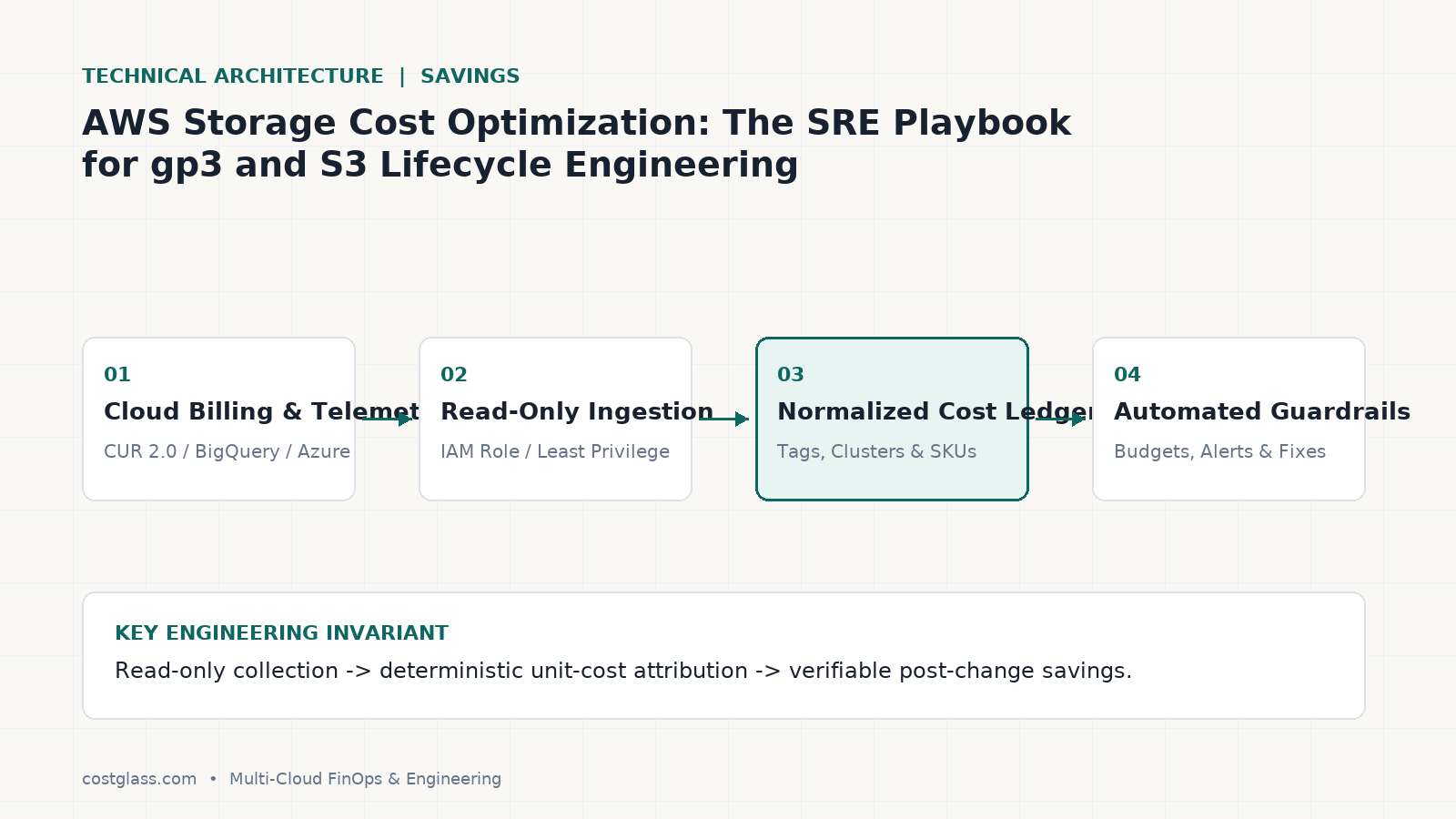
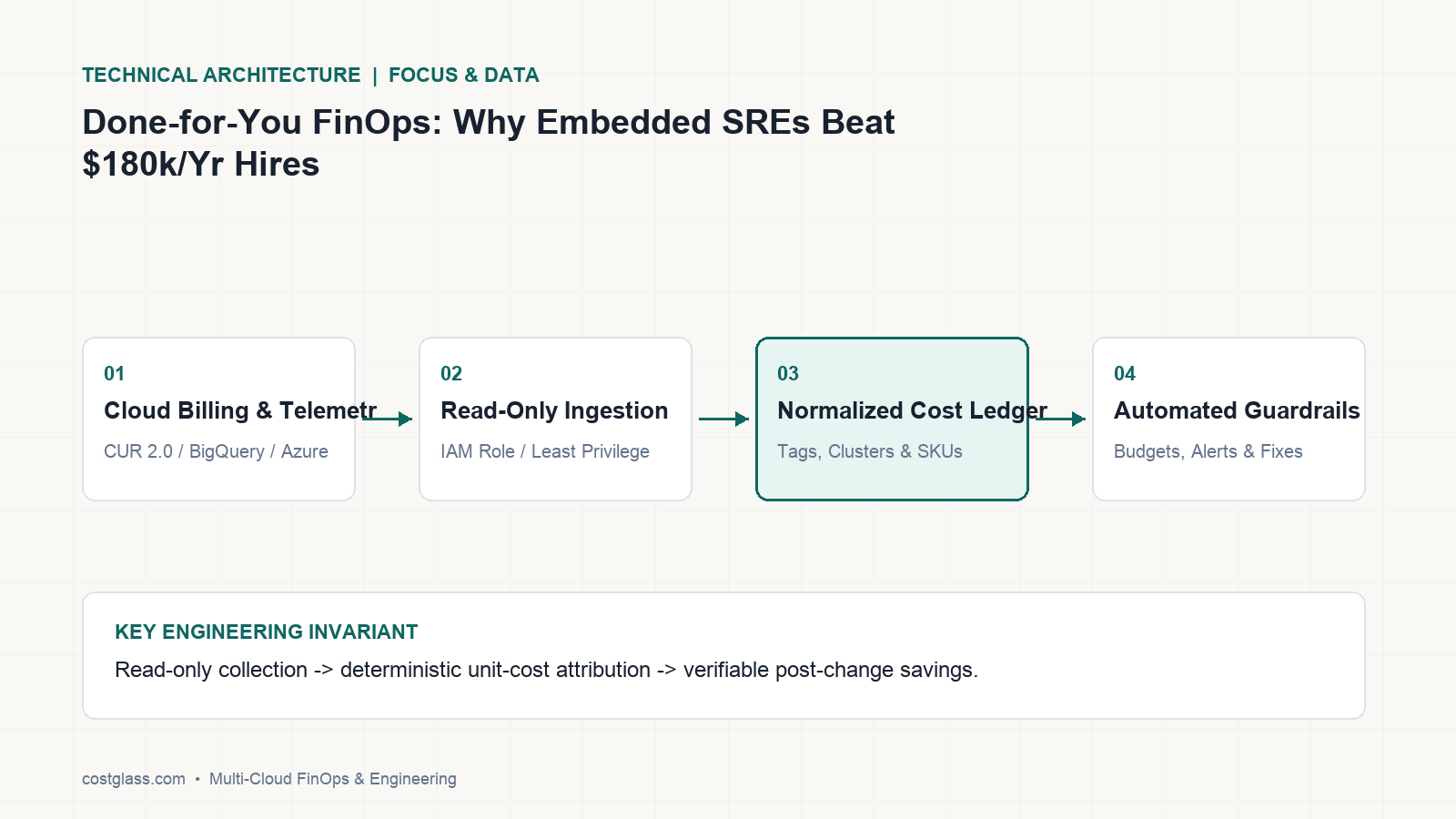
Instead of burning $100,000+ in engineering payroll on a fragile, home-grown dashboard, CostGlass connects natively to your infrastructure in five minutes. Our platform unifies all 13 cloud, Kubernetes, data, and AI connectors into a normalized cross-cloud billing ledger, giving you instant, production-ready visibility with zero maintenance overhead.
How to Deploy & Leverage CostGlass Embedded SREs in 5 Minutes
Transitioning from passive dashboard alerts to active, engineered savings with CostGlass is a straightforward process:
Step 1: Connect Your Infrastructure Safely
CostGlass connects to your cloud environments using read-only, highly secure IAM roles. We never store long-lived credentials or write keys. For AWS, you can deploy our secure connector via a 1-click CloudFormation template or our custom Terraform generator using a unique ExternalId to enforce strict least-privilege security.
Here is an example of the read-only IAM policy used to connect your AWS environment to CostGlass:
{
  "Version": "2012-10-17",
  "Statement": [
    {
      "Effect": "Allow",
      "Action": [
        "aws-portal:ViewBilling",
        "aws-portal:ViewUsage",
        "budgets:ViewBudget",
        "cur:DescribeReportDefinitions",
        "organizations:DescribeOrganization",
        "organizations:ListAccounts",
        "ce:Get*",
        "ce:List*"
      ],
      "Resource": "*"
    }
  ]
}
Step 2: Let CostGlass Build Your Unified Ledger
Within hours, CostGlass ingests and normalizes your billing data across AWS, Azure, GCP, Kubernetes, Snowflake, Datadog, and your AI providers. Our platform runs automated anomaly detection, rightsizing analysis, and scheduling evaluations.
Step 3: Task Your Dedicated CostGlass SREs
As a Scale plan subscriber, you have direct access to your dedicated senior DevOps/FinOps engineers. We don't just dump a list of suggestions on your desk. We work with your team to:
- Configure the automated Multi-Cloud Instance Scheduler to safely shut down dev/staging idle resources outside of business hours.
- Write and test Terraform PRs to migrate legacy
gp2volumes to high-performance, cost-effectivegp3storage. - Clean up unattached Elastic IPs, orphaned EBS volumes, and idle NAT Gateways.
- Model commitment purchases (Savings Plans, RIs, and GCP CUDs) inside our What-If Simulator to maximize coverage without over-committing.
By letting our embedded engineers execute these optimizations, you free up your internal team to focus entirely on product velocity while your cloud bill shrinks predictably.
Frequently Asked Questions
How do CostGlass engineers safely execute changes in our environments?
Our embedded senior SREs operate with strict governance. We do not require direct write access to your production accounts. Instead, we write the necessary Terraform, CloudFormation, or shell scripts and submit them as pull requests (PRs) directly to your engineering team's repository. Your team retains full control over the approval and deployment process.
Why doesn't CostGlass charge a percentage of savings?
We believe percentage-of-savings pricing models (like nOps) are fundamentally misaligned with customer success. They function as a tax on your engineering efficiency. With CostGlass, you pay a flat monthly fee based on your cloud spend tier. If our engineers save you $20,000 this month, you keep 100% of that $20,000.
Can we transition from software-only to the Scale plan at any time?
Yes. CostGlass features transparent, rolling month-to-month billing with no annual contract lock-ins. You can start on our Starter or Growth plans for self-serve visibility, and upgrade to the Scale plan whenever you need hands-on engineering assistance to execute a major cost-reduction initiative.
Ready to bridge the execution gap and start saving? Explore our transparent, flat-rate tiers on our pricing page, compare us directly to legacy platforms with our CloudZero comparison guide, or learn how to maximize your engineering efficiency in our Savings Playbook.
Contratar a un ingeniero de FinOps a tiempo completo cuesta más de $180,000 al año, mientras que los paneles de control de solo software heredados dejan a los ingenieros con un backlog interminable en Jira sin ejecutar. CostGlass resuelve esta brecha de ejecución. Por una tarifa plana de $1,499/mes en nuestro plan Scale, combinamos visibilidad de costes multicloud con 8 horas de ejecución técnica práctica por parte de SREs sénior para escribir PRs de Terraform, configurar programadores y redimensionar cargas de trabajo de forma segura, garantizando que usted conserve el 100% de sus ahorros.
La brecha de ejecución de FinOps: por qué fallan los paneles basados únicamente en software
Cualquier organización de ingeniería moderna conoce una variante de la misma historia: adquiere una herramienta tradicional de FinOps, conecta sus cuentas cloud y espera a que lleguen los ahorros. En su lugar, se encuentra con un panel de control atractivo y complejo que contiene 400 recomendaciones sin resolver.
Su panel le indica que tiene $12,000 en volúmenes EBS desconectados, tres instancias de Amazon RDS sobredimensionadas y veinte entornos de desarrollo ejecutándose 24/7. Sin embargo, no ocurre nada. ¿Por qué?
Porque sus ingenieros de plataforma, SREs y desarrolladores de producto están totalmente asignados a lanzar funcionalidades que generan ingresos. No disponen del tiempo necesario para revisar listas de recomendaciones heredadas, verificar dependencias de aplicaciones, redactar pull requests en Terraform y ejecutar el redimensionamiento de forma segura. Las recomendaciones permanecen en el backlog de Jira durante meses mientras el desperdicio en la nube continúa acumulándose.
Esta es la brecha de ejecución de FinOps. Las herramientas basadas únicamente en software como CloudZero, Vantage y Finout son excelentes para señalar el gasto superfluo, pero delegan la compleja labor de remediación en su ya sobrecargado equipo. Este enfoque pasivo ralentiza de forma drástica el tiempo hasta materializar el ahorro y le atrapa en un ciclo frustrante de pagar por un software que en realidad no reduce su factura.
El coste real de una contratación dedicada de FinOps frente a la ingeniería gestionada
Para cerrar esta brecha de ejecución, muchos directores financieros y vicepresidentes de ingeniería contemplan la contratación a tiempo completo de un ingeniero de FinOps o un analista financiero cloud. No obstante, la realidad económica de una contratación dedicada rara vez encaja con las necesidades de una empresa SaaS del mid-market o en fase de crecimiento.
Un ingeniero FinOps sénior o un Cloud SRE cualificado exige un salario base de entre $150,000 y $180,000 en el mercado actual. Si añade cargas sociales, seguro médico, equity, costes de selección, desfase de incorporación (onboarding) y gastos de gestión, el coste total de contratación supera con creces los $220,000 al año (aproximadamente $18,300 al mes).
Además, la mayoría de las organizaciones del mid-market no requieren 160 horas mensuales de trabajo continuo de FinOps. Tras la fase inicial de saneamiento —que implica configurar políticas de etiquetado, programar apagados de instancias y adquirir compromisos iniciales—, la carga operativa recurrente desciende de manera notable. Se termina abonando un salario a tiempo completo por un recurso cuyas competencias especializadas solo se aprovechan al 100% entre un 10% y un 20% del tiempo.
El Plan Scale de CostGlass ($1,499/mes) replantea por completo este modelo. Al combinar nuestra plataforma de costes multicloud con 8 horas mensuales dedicadas de ingenieros sénior de DevOps y FinOps, obtiene lo mejor de ambos mundos: visibilidad automatizada con refrescos cada 6 horas mediante 13 conectores nativos y un equipo de ingeniería de élite que materializa los ahorros por usted.
Nuestros ingenieros escriben el código de Terraform, eliminan de forma segura recursos huérfanos, configuran planificadores y gestionan su cartera de compromisos. Disfruta de la capacidad de ejecución de una contratación sénior por menos del 10% de su coste.
Modelo financiero: CostGlass Scale vs. Contratación interna vs. Software tradicional
Examinemos los números financieros concretos y las capacidades técnicas de los tres enfoques principales para optimizar los costes en la nube:
| Característica / Métrica | Software tradicional (ej. CloudZero) | Contratación FinOps dedicada | CostGlass Plan Scale |
|---|---|---|---|
| Coste directo mensual | Contrato anual opaco ($2k - $8k/mes) | ~$18,300/mes (coste total empresa) | $1,499/mes (tarifa plana) |
| Ejecución de la remediación | Ninguna (solo recomendaciones en software) | Ejecución manual a tiempo completo | Incluida (8 horas de SRE/mes) |
| Filosofía de precios | Porcentaje del gasto o permanencia anual | Coste salarial fijo | 0% de comisión por ahorro (tarifa plana mensual) |
| Costes de Kubernetes y SaaS | Tarifas adicionales o integraciones a medida | Requiere scripting manual | Incluido (OpenCost, Snowflake, IA) |
| Residencia soberana de datos | Alojamiento exclusivo en EE. UU. (Vantage) | N/A (Interno) | Células regionales en UK, EU, US y APAC |
| Tiempo hasta lograr ahorros | Lento (depende de la ingeniería interna) | Medio (3-6 meses de contratación y onboarding) | Inmediato (los SREs ejecutan en días) |
La trampa de construir frente a comprar: el coste oculto de los pipelines de costes internos
Al enfrentarse a un aumento descontrolado en las facturas de la nube, algunos responsables técnicos intentan construir sus propios pipelines internos de seguimiento de costes. Escriben scripts en Python para procesar exportaciones de AWS CUR 2.0 en S3, consultan APIs de Azure Cost Management o construyen paneles personalizados en Looker o Grafana.
Esta es una trampa clásica de ingeniería. Mantener internamente una canalización de costes multicloud sólida resulta extraordinariamente costoso:
- Esquemas frágiles: Los esquemas de facturación en la nube cambian de manera constante. Una simple actualización de API por parte de AWS, Azure o GCP puede romper de inmediato sus pipelines de ingesta.
- Normalización multicloud: Unificar AWS CUR 2.0, exportaciones de Azure MCA, métricas de Kubernetes OpenCost y el consumo de tokens de la API de OpenAI en un registro unificado y coherente exige un desarrollo ETL complejo y continuo.
- Coste de oportunidad: Cada hora que sus ingenieros principales dedican a depurar pipelines de facturación, programar tareas cron o mantener esquemas de bases de datos es una hora que no dedican a desarrollar funcionalidades clave para el producto y el negocio.
En lugar de consumir más de $100,000 de nómina técnica en un panel artesanal y frágil, CostGlass se conecta de forma nativa a su infraestructura en cinco minutos. Nuestra plataforma unifica 13 conectores de nube, Kubernetes, datos e IA en un libro contable de facturación multicloud normalizado, ofreciéndole visibilidad inmediata para entornos de producción sin sobrecarga de mantenimiento.
Cómo desplegar y aprovechar los SREs integrados de CostGlass en 5 minutos
Pasar de alertas pasivas en un panel a ahorros de ingeniería ejecutados con CostGlass es un proceso directo:
Paso 1: Conecte su infraestructura de forma segura
CostGlass se conecta a sus entornos de nube mediante roles de IAM de solo lectura y máxima seguridad. Nunca almacenamos credenciales de larga duración ni claves de escritura. Para AWS, puede desplegar nuestro conector seguro mediante una plantilla de CloudFormation en 1 clic o con nuestro generador personalizado de Terraform, utilizando un ExternalId único para garantizar una seguridad estricta basada en mínimos privilegios.
A continuación se muestra un ejemplo de la directiva IAM de solo lectura utilizada para conectar su entorno de AWS a CostGlass:
{
  "Version": "2012-10-17",
  "Statement": [
    {
      "Effect": "Allow",
      "Action": [
        "aws-portal:ViewBilling",
        "aws-portal:ViewUsage",
        "budgets:ViewBudget",
        "cur:DescribeReportDefinitions",
        "organizations:DescribeOrganization",
        "organizations:ListAccounts",
        "ce:Get*",
        "ce:List*"
      ],
      "Resource": "*"
    }
  ]
}
Paso 2: Deje que CostGlass construya su registro unificado
En cuestión de horas, CostGlass ingiere y normaliza sus datos de facturación en AWS, Azure, GCP, Kubernetes, Snowflake, Datadog y sus proveedores de IA. Nuestra plataforma ejecuta detección automática de anomalías, análisis de rightsizing y evaluaciones de calendarización.
Paso 3: Asigne tareas a sus SREs dedicados de CostGlass
Como suscriptor del plan Scale, tiene acceso directo a sus ingenieros sénior asignados de DevOps/FinOps. No nos limitamos a entregarle una lista de sugerencias. Trabajamos codo con codo con su equipo para:
- Configurar el Multi-Cloud Instance Scheduler automatizado para apagar de forma segura recursos inactivos de desarrollo y staging fuera de las horas laborables.
- Redactar y validar PRs de Terraform para migrar volúmenes heredados
gp2a almacenamientogp3, más rentable y de alto rendimiento. - Eliminar IPs elásticas sin asociar, volúmenes EBS huérfanos y NAT Gateways inactivos.
- Modelar compras de compromisos (Savings Plans, RIs y GCP CUDs) dentro de nuestro simulador hipotético (What-If Simulator) para optimizar la cobertura sin compromisos excesivos.
Al permitir que nuestros ingenieros integrados ejecuten estas optimizaciones, su equipo interno queda liberado para centrarse exclusivamente en el avance del producto mientras su factura cloud se reduce de manera predecible.
Preguntas frecuentes
¿Cómo ejecutan cambios de manera segura los ingenieros de CostGlass en nuestros entornos?
Nuestros SREs sénior integrados operan bajo un gobierno estricto. No requerimos acceso directo de escritura a sus cuentas de producción. En su lugar, escribimos el código necesario en Terraform, CloudFormation o scripts de shell y los enviamos como pull requests (PRs) directamente al repositorio de su equipo de ingeniería. Su equipo mantiene en todo momento el control absoluto sobre la aprobación y el despliegue.
¿Por qué CostGlass no cobra un porcentaje de los ahorros?
Creemos que los modelos basados en un porcentaje del ahorro (como nOps) están desalineados con el éxito del cliente. Actúan como un impuesto sobre la eficiencia de su ingeniería. Con CostGlass, paga una tarifa plana mensual en función de su nivel de gasto en la nube. Si nuestros ingenieros le ahorran $20,000 este mes, usted conserva el 100% de esos $20,000.
¿Podemos cambiar del plan solo de software al plan Scale en cualquier momento?
Sí. CostGlass ofrece facturación transparente de mes a mes, sin permanencias ni contratos anuales obligatorios. Puede comenzar con nuestros planes Starter o Growth para obtener visibilidad de autoservicio y migrar al plan Scale en cuanto necesite asistencia técnica práctica para ejecutar un plan de choque en la reducción de costes.
¿Listo para cerrar la brecha de ejecución y comenzar a ahorrar? Explore nuestras tarifas planas y transparentes en nuestra página de precios, compárenos directamente con plataformas heredadas en nuestra guía comparativa con CloudZero o descubra cómo optimizar su eficiencia de ingeniería en nuestro Savings Playbook.
Die Einstellung eines Vollzeit-FinOps-Engineers kostet jährlich über 180.000 Dollar, während herkömmliche reine Software-Dashboards Entwickler mit unbearbeiteten Jira-Backlogs allein lassen. CostGlass schließt diese Umsetzungslücke. Für eine feste Monatspauschale von 1.499 $ in unserem Scale-Tarif kombinieren wir Multi-Cloud-Kostentransparenz mit 8 Stunden praktischer Unterstützung durch Senior SREs: Wir erstellen Terraform-PRs, konfigurieren Scheduler und führen Workload-Rightsizing sicher durch – damit Sie 100 % Ihrer Einsparungen behalten.
Die FinOps-Umsetzungslücke: Warum reine Software-Dashboards scheitern
Jede moderne Engineering-Organisation kennt dieselbe Geschichte: Sie erwerben ein klassisches FinOps-Tool, binden Ihre Cloud-Accounts an und warten darauf, dass sich die Einsparungen von selbst einstellen. Stattdessen blicken Sie auf ein optisch ansprechendes, aber komplexes Dashboard mit 400 ungelösten Empfehlungen.
Ihr Dashboard meldet Ihnen ungenutzte EBS-Volumes im Wert von 12.000 $, drei überdimensionierte Amazon RDS-Instanzen und zwanzig Entwicklungsumgebungen, die rund um die Uhr laufen. Dennoch passiert nichts. Warum?
Weil Ihre Platform Engineers, SREs und Produktentwickler voll damit ausgelastet sind, umsatzrelevante Features auszuliefern. Ihnen fehlen die zeitlichen Kapazitäten, endlose Empfehlungslisten durchzugehen, Anwendungsabhängigkeiten zu prüfen, Terraform-Pull-Requests zu schreiben und Rightsizing gefahrlos durchzuführen. Die Empfehlungen verharren monatelang im Jira-Backlog, während die Cloud-Verschwendung kontinuierlich zunimmt.
Das ist die FinOps-Umsetzungslücke (FinOps Execution Gap). Reine Softwarelösungen wie CloudZero, Vantage und Finout zeigen Ineffizienzen hervorragend auf, überlassen die harte Arbeit der Behebung jedoch komplett Ihren ohnehin überlasteten Teams. Dieser passive Ansatz verzögert die Time-to-Savings massiv und führt in eine frustrierende Schleife, in der Sie für Software bezahlen, die Ihre Cloud-Rechnung nicht messbar senkt.
Die wahren Kosten einer dedizierten FinOps-Stelle vs. Done-for-You Engineering
Um diese Umsetzungslücke zu schließen, erwägen viele CFOs und VPs of Engineering die Einstellung eines internen, festangestellten FinOps Engineers oder Cloud Financial Analysts. Die wirtschaftliche Realität einer Vollzeitstelle deckt sich jedoch selten mit den Anforderungen eines mittelständischen SaaS-Unternehmens oder eines wachsenden Mittelständlers.
Ein qualifizierter Senior FinOps Engineer oder Cloud SRE verlangt auf dem heutigen Markt ein Grundgehalt von 150.000 bis 180.000 Dollar. Berücksichtigt man Lohnnebenkosten, Krankenversicherung, Unternehmensanteile, Personalbeschaffungskosten, Einarbeitungszeit und Management-Overhead, übersteigen die Gesamtkosten (Fully Loaded Cost) schnell 220.000 Dollar pro Jahr (ca. 18.300 Dollar monatlich).
Zudem fällt in den meisten Unternehmen kein kontinuierlicher Arbeitsaufwand von 160 FinOps-Stunden pro Monat an. Nach der initialen Aufräumphase – der Einrichtung von Tagging-Richtlinien, Instanz-Schedulern und dem ersten Erwerb von Commitments – sinkt die laufende operative Arbeitslast drastisch. Am Ende bezahlen Sie ein volles Jahresgehalt für eine Fachkraft, deren Spezialwissen nur noch zu 10 bis 20 % ausgelastet ist.
Der Scale-Tarif von CostGlass (1.499 $/Monat) definiert dieses Modell grundlegend neu. Durch die Verknüpfung unserer Multi-Cloud-Kostenplattform mit 8 Stunden dedizierter Arbeitszeit von Senior DevOps- und FinOps-Engineers pro Monat vereinen wir das Beste aus zwei Welten: automatisierte Kostentransparenz mit 6-Stunden-Aktualisierung über 13 native Konnektoren und ein erstklassiges Engineering-Team, das die Einsparungen direkt für Sie umsetzt.
Unsere Engineers schreiben den Terraform-Code, bereinigen verwaiste Ressourcen gefahrlos, konfigurieren Zeitpläne und steuern Ihr Commitment-Portfolio. Sie erhalten die Umsetzungsstärke eines Senior-Engineers zu weniger als 10 % der üblichen Personalkosten.
Finanzmodellierung: CostGlass Scale vs. Festanstellung vs. Legacy-Software
Ein Blick auf die Zahlen und Fähigkeiten verdeutlicht die Unterschiede zwischen den drei zentralen Ansätzen zur Cloud-Kostenoptimierung:
| Feature / Metrik | Reine Legacy-Software (z. B. CloudZero) | Dedizierte FinOps-Festanstellung | CostGlass Scale-Tarif |
|---|---|---|---|
| Monatliche Direktkosten | Intransparenter Jahresvertrag (2.000 $ – 8.000 $/Mo.) | ~18.300 $/Mo. (Vollkosten) | 1.499 $/Mo. (Pauschaltarif) |
| Umsetzung der Behebung | Keine (Nur Software-Empfehlungen) | Manuelle Vollzeit-Umsetzung | Inklusive (8 SRE-Stunden/Mo.) |
| Preisphilosophie | Prozentualer Ausgabenanteil oder Jahresbindung | Fixe Lohn- und Gehaltskosten | 0 % Einsparungsgebühr (Feste Monatspauschale) |
| Kubernetes- & SaaS-Kosten | Zusätzliche Add-on-Kosten oder eigene Integrationen | Manuelle Skripterstellung nötig | Inklusive (OpenCost, Snowflake, AI) |
| Datensouveränität & Residenz | Nur US-Hosting (Vantage) | Entfällt (Intern) | Regionale Zellen in UK, EU, US und APAC |
| Time-to-Savings | Langsam (Abhängig von internen Entwicklern) | Mittel (3–6 Monate Recruiting & Onboarding) | Sofort (SREs setzen Maßnahmen binnen Tagen um) |
Die Build-vs-Buy-Falle: Die versteckten Kosten interner Kosten-Pipelines
Angesichts steigender Cloud-Rechnungen versuchen einige Engineering-Leiter, interne Daten-Pipelines zur Kostenüberwachung selbst zu entwickeln. Sie programmieren Python-Skripte, um AWS CUR 2.0 S3-Exporte zu verarbeiten, fragen Azure Cost Management APIs ab oder bauen Dashboards in Looker oder Grafana.
Dies ist eine typische Entwicklerfalle. Der Eigenbau einer belastbaren Multi-Cloud-Kosten-Pipeline verursacht enorme Wartungskosten:
- Instabile Schemas: Abrechnungsschemas der Cloud-Anbieter ändern sich fortlaufend. Eine einzige API-Anpassung bei AWS, Azure oder GCP kann Ihre Ingestion-Pipelines unvermittelt lahmlegen.
- Multi-Cloud-Normalisierung: Das Zusammenführen von AWS CUR 2.0, Azure MCA-Exporten, Kubernetes OpenCost-Metriken und OpenAI-API-Token-Nutzung in einem einheitlichen Ledger erfordert kontinuierliche, komplexe ETL-Entwicklung.
- Opportunitätskosten: Jede Stunde, die Ihre Principal Engineers mit dem Debuggen von Billing-Pipelines, Cron-Jobs oder Datenbankschemas verbringen, fehlt bei der Weiterentwicklung Ihres eigentlichen Kernprodukts.
Statt über 100.000 Dollar an Entwicklergehältern in ein instabiles internes Dashboard zu investieren, binden Sie CostGlass in fünf Minuten nativ an Ihre Infrastruktur an. Unsere Plattform führt 13 Cloud-, Kubernetes-, Daten- und KI-Konnektoren in einem normalisierten, anbieterübergreifenden Billing-Ledger zusammen – für sofortige, produktionsreife Transparenz ohne Wartungsaufwand.
So implementieren und nutzen Sie CostGlass Embedded SREs in 5 Minuten
Der Wechsel von passiven Dashboard-Warnungen zu aktiven, technisch implementierten Einsparungen gelingt mit CostGlass in wenigen Schritten:
Schritt 1: Binden Sie Ihre Infrastruktur sicher an
CostGlass verbindet sich über hochsichere IAM-Rollen mit ausschließlich lesendem Zugriff (Read-Only) mit Ihren Cloud-Umgebungen. Wir speichern niemals langlebige Anmeldedaten oder Schreibschlüssel. Für AWS können Sie unseren Connector über eine 1-Klick-CloudFormation-Vorlage oder unseren individuellen Terraform-Generator bereitstellen, der über eine eindeutige ExternalId ein striktes Least-Privilege-Sicherheitsmodell erzwingt.
Hier ist ein Beispiel für die schreibgeschützte IAM-Policy zur Anbindung Ihrer AWS-Umgebung an CostGlass:
{
  "Version": "2012-10-17",
  "Statement": [
    {
      "Effect": "Allow",
      "Action": [
        "aws-portal:ViewBilling",
        "aws-portal:ViewUsage",
        "budgets:ViewBudget",
        "cur:DescribeReportDefinitions",
        "organizations:DescribeOrganization",
        "organizations:ListAccounts",
        "ce:Get*",
        "ce:List*"
      ],
      "Resource": "*"
    }
  ]
}
Schritt 2: CostGlass erstellt Ihren einheitlichen Ledger
Innerhalb weniger Stunden erfasst und normalisiert CostGlass Ihre Abrechnungsdaten über AWS, Azure, GCP, Kubernetes, Snowflake, Datadog und Ihre KI-Provider hinweg. Die Plattform führt automatische Anomalieerkennungen, Rightsizing-Analysen und Scheduling-Bewertungen durch.
Schritt 3: Beauftragen Sie Ihre dedizierten CostGlass SREs
Als Abonnent des Scale-Tarifs haben Sie direkten Zugriff auf Ihre festen Senior DevOps- und FinOps-Engineers. Wir hinterlassen nicht bloß eine Liste ungelöster Empfehlungen auf Ihrem Schreibtisch, sondern arbeiten Hand in Hand mit Ihrem Team:
- Konfiguration des automatisierten Multi-Cloud Instance Scheduler, um ungenutzte Entwicklungs- und Staging-Ressourcen außerhalb der Arbeitszeiten sicher herunterzufahren.
- Erstellung und Test von Terraform-PRs zur Migration veralteter
gp2-Volumes auf performantere und kostengünstigeregp3-Speicher. - Bereinigung nicht zugewiesener Elastic IPs, verwaister EBS-Volumes und ungenutzter NAT Gateways.
- Modellierung von Commitment-Käufen (Savings Plans, RIs und GCP CUDs) in unserem What-If-Simulator, um die Abdeckung ohne Überbindung zu maximieren.
Indem unsere Embedded Engineers diese Optimierungen direkt umsetzen, halten Sie Ihrem internen Team den Rücken frei für die Produktentwicklung, während Ihre Cloud-Ausgaben planbar sinken.
Häufig gestellte Fragen (FAQ)
Wie führen CostGlass-Engineers Änderungen in unseren Umgebungen sicher durch?
Unsere fest zugeordneten Senior SREs arbeiten nach strengen Governance-Standards. Wir fordern keinen direkten Schreibzugriff auf Ihre Produktionskonten an. Stattdessen erstellen wir die erforderlichen Terraform-, CloudFormation- oder Shell-Skripte und reichen sie als Pull Requests (PRs) direkt im Repository Ihres Teams ein. Ihr Team behält zu jedem Zeitpunkt die volle Kontrolle über Review-, Genehmigungs- und Deployment-Prozesse.
Warum verlangt CostGlass keinen prozentualen Anteil an den Einsparungen?
Wir sind überzeugt, dass prozentuale Abrechnungsmodelle (wie bei nOps) dem Kundenerfolg grundlegend widersprechen. Sie wirken wie eine Strafsteuer auf Ihre technische Effizienz. Bei CostGlass zahlen Sie eine planbare monatliche Pauschale auf Basis Ihres Cloud-Ausgabenbereichs. Wenn unsere Engineers diesen Monat 20.000 $ für Sie einsparen, verbleiben 100 % dieser 20.000 $ vollständig bei Ihnen.
Können wir jederzeit vom reinen Software-Zugang in den Scale-Tarif wechseln?
Ja. CostGlass bietet transparente, monatlich kündbare Abonnements ohne langwierige Vertragsbindungen. Sie können zur reinen Kostentransparenz mit unserem Starter- oder Growth-Tarif beginnen und jederzeit auf den Scale-Tarif upgraden, sobald Sie praktische Unterstützung durch unsere Engineers für umfassendere Optimierungsprojekte benötigen.
Sind Sie bereit, die Umsetzungslücke zu schließen und sofort Kosten zu senken? Entdecken Sie unsere transparenten Pauschaltarife auf unserer Preisseite, vergleichen Sie uns direkt mit Legacy-Plattformen in unserem CloudZero-Vergleichsleitfaden oder erfahren Sie mehr über effiziente Optimierungsstrategien in unserem Savings Playbook.
Recruter un ingénieur FinOps à temps plein coûte plus de 180 000 $ par an, tandis que les tableaux de bord logiciels classiques laissent vos développeurs face à un backlog Jira sans fin. CostGlass comble ce déficit d'exécution. Pour un tarif fixe de 1 499 $/mois avec notre forfait Scale, nous combinons une visibilité financière multi-cloud avec 8 heures d'intervention directe d'un SRE senior pour rédiger des pull requests Terraform, configurer des planificateurs et redimensionner vos charges de travail en toute sécurité — tout en vous garantissant de conserver 100 % de vos économies.
Le déficit d'exécution FinOps : pourquoi les tableaux de bord logiciels échouent
Toutes les organisations d'ingénierie modernes partagent la même histoire : vous souscrivez à un outil FinOps traditionnel, vous connectez vos comptes cloud et vous attendez que les économies se concrétisent. À la place, vous découvrez un tableau de bord élégant mais complexe, saturé de 400 recommandations non traitées.
Votre interface vous signale 12 000 $ de volumes EBS orphelins, trois instances Amazon RDS surdimensionnées et vingt environnements de développement actifs 24h/24 et 7j/7. Pourtant, rien ne change. Pourquoi ?
Parce que vos ingénieurs de plateforme, vos SRE et vos développeurs produit sont entièrement mobilisés sur le déploiement de fonctionnalités génératrices de revenus. Ils n'ont pas la bande passante nécessaire pour éplucher de longues listes de recommandations, vérifier les dépendances applicatives, rédiger des PR Terraform et procéder au redimensionnement en toute sécurité. Les tickets s'accumulent dans votre backlog Jira pendant des mois, laissant le gaspillage cloud s'amplifier.
C'est précisément le déficit d'exécution FinOps. Les solutions logicielles passives telles que CloudZero, Vantage ou Finout excellent pour identifier le gaspillage, mais délèguent l'intégralité du travail de remédiation à vos équipes déjà surchargées. Cette approche passive ralentit considérablement la rentabilisation de vos efforts et vous enferme dans un cercle vicieux consistant à payer un logiciel sans observer de baisse réelle sur votre facture.
Le coût réel d'un recrutement FinOps dédié face à l'ingénierie clé en main
Pour surmonter ce déficit d'exécution, de nombreux CFO et directeurs techniques envisagent d'embaucher un ingénieur FinOps ou un analyste financier cloud à temps plein. Cependant, la réalité économique d'une embauche dédiée correspond rarement aux besoins d'une entreprise SaaS du mid-market ou en pleine croissance.
Un ingénieur FinOps senior ou un Cloud SRE qualifié perçoit un salaire de base oscillant entre 150 000 $ et 180 000 $ sur le marché actuel. En intégrant les charges sociales, la mutuelle, les stock-options, les frais de recrutement, la période d'intégration et les coûts de gestion, le coût global employeur dépasse facilement 220 000 $ par an (soit environ 18 300 $ par mois).
De plus, la plupart des entreprises de taille intermédiaire n'ont pas 160 heures par mois de tâches FinOps continues. Une fois le nettoyage initial accompli — implémentation de la politique de tags, mise en place des planificateurs d'instances et souscription des premiers engagements —, la charge de travail opérationnelle diminue considérablement. Vous vous retrouvez à payer un salaire annuel complet pour une ressource experte dont les compétences pointues ne sont réellement exploitées qu'à 10 % ou 20 % du temps.
Le forfait Scale de CostGlass (1 499 $/mois) repense entièrement ce modèle. En associant notre plateforme de coûts multi-cloud à 8 heures par mois d'ingénieurs seniors DevOps et FinOps dédiés, vous profitez du meilleur des deux approches : une visibilité actualisée toutes les 6 heures via 13 connecteurs natifs, et une équipe d'ingénierie d'élite qui concrétise réellement les économies pour vous.
Nos ingénieurs rédigent le code Terraform, nettoient vos ressources orphelines sans risque, configurent les plannings d'extinction et gèrent votre portefeuille d'engagements. Vous bénéficiez du savoir-faire d'un profil senior pour moins de 10 % de son coût réel.
Modélisation financière : CostGlass Scale vs Recrutement vs Logiciel traditionnel
Examinons les chiffres concrets et les capacités associées à chacune des trois grandes approches de l'optimisation des coûts cloud :
| Fonctionnalité / Indicateur | Outil logiciel traditionnel (ex. CloudZero) | Embauche FinOps dédiée | Forfait CostGlass Scale |
|---|---|---|---|
| Coût direct mensuel | Contrat annuel opaque (2 k$ à 8 k$/mois) | ~18 300 $/mois (coût global) | 1 499 $/mois (prix fixe) |
| Exécution de la remédiation | Aucune (recommandations logicielles seules) | Exécution manuelle à temps plein | Incluse (8 h SRE/mois) |
| Modèle tarifaire | Pourcentage des dépenses ou engagement annuel | Coûts salariaux fixes | 0 % de taxe sur les économies (Forfait mensuel) |
| Coûts Kubernetes & SaaS | Frais additionnels ou intégrations sur mesure | Scripts manuels requis | Inclus (OpenCost, Snowflake, IA) |
| Souveraineté des données | Hébergement US exclusif (Vantage) | N/A (Interne) | Cellules régionales UK, EU, US, APAC |
| Délai d'obtention des gains | Lent (Dépend de vos ingénieurs internes) | Moyen (3 à 6 mois d'embauche et d'onboarding) | Immédiat (Exécution SRE sous quelques jours) |
Le piège du « Build vs Buy » : le coût caché des pipelines de données internes
Face à l'inflation de leurs factures cloud, certains responsables techniques tentent de bâtir leur propre système interne de suivi financier. Ils rédigent des scripts Python ad hoc pour parser les exports S3 d'AWS CUR 2.0, interroger les API Azure Cost Management ou construire des tableaux de bord sur Looker ou Grafana.
C'est un piège d'ingénierie classique. Développer et maintenir en interne un pipeline de données financières multi-cloud s'avère particulièrement onéreux :
- Schémas instables : La structure des données de facturation cloud évolue en permanence. Une simple mise à jour d'API chez AWS, Azure ou GCP peut casser instantanément vos pipelines d'ingestion.
- Normalisation multi-cloud : Unifier AWS CUR 2.0, les exports Azure MCA, les métriques Kubernetes OpenCost et la consommation de jetons des API OpenAI au sein d'un grand livre cohérent exige un développement ETL permanent et complexe.
- Coût d'opportunité : Chaque heure passée par vos ingénieurs principaux à déboguer des flux de facturation, écrire des tâches cron ou modifier des schémas de base de données est une heure perdue pour le développement de fonctionnalités stratégiques qui génèrent du chiffre d'affaires.
Au lieu d'engloutir plus de 100 000 $ de budget d'ingénierie dans un tableau de bord maison fragile, CostGlass se connecte nativement à votre infrastructure en cinq minutes. Notre plateforme unifie l'ensemble des 13 connecteurs cloud, Kubernetes, data et IA au sein d'un grand livre normalisé, vous offrant une visibilité immédiate et prête pour la production, sans aucune charge de maintenance.
Déployer et mobiliser les SRE intégrés CostGlass en 5 minutes
Passer d'alertes passives à des économies concrètes et encadrées avec CostGlass s'effectue en quelques étapes simples :
Étape 1 : Connectez votre infrastructure en toute sécurité
CostGlass s'interface avec vos environnements cloud grâce à des rôles IAM en lecture seule hautement sécurisés. Nous ne stockons aucun identifiant permanent ni clé d'écriture. Sur AWS, le connecteur se déploie via un modèle CloudFormation en 1 clic ou notre générateur Terraform sur mesure, exploitant un identifiant ExternalId unique pour appliquer strictement le principe du moindre privilège.
Voici un exemple de politique IAM en lecture seule utilisée pour relier votre environnement AWS à CostGlass :
{
  "Version": "2012-10-17",
  "Statement": [
    {
      "Effect": "Allow",
      "Action": [
        "aws-portal:ViewBilling",
        "aws-portal:ViewUsage",
        "budgets:ViewBudget",
        "cur:DescribeReportDefinitions",
        "organizations:DescribeOrganization",
        "organizations:ListAccounts",
        "ce:Get*",
        "ce:List*"
      ],
      "Resource": "*"
    }
  ]
}
Étape 2 : Laissez CostGlass générer votre grand livre unifié
En quelques heures, CostGlass ingère et normalise vos données de facturation issues d'AWS, Azure, GCP, Kubernetes, Snowflake, Datadog et de vos fournisseurs d'IA. Notre moteur déclenche automatiquement la détection d'anomalies, l'analyse du dimensionnement et l'évaluation des plages d'extinction.
Étape 3 : Confiez vos chantiers aux SRE dédiés CostGlass
En tant qu'abonné au forfait Scale, vous interagissez directement avec vos ingénieurs DevOps/FinOps seniors dédiés. Nous ne nous contentons pas de vous envoyer une liste de recommandations. Nous collaborons étroitement avec vos équipes pour :
- Déployer le planificateur d'instances multi-cloud automatisé afin d'éteindre sans risque les ressources de test/staging inactives en dehors des heures de bureau.
- Rédiger et tester des PR Terraform pour faire évoluer les volumes obsolètes
gp2vers le stockagegp3, plus performant et économique. - Supprimer les Elastic IP non assignées, les volumes EBS orphelins et les NAT Gateways inactives.
- Modéliser vos stratégies de réservation (Savings Plans, RIs et GCP CUDs) via notre simulateur prédictif What-If pour maximiser votre couverture sans risque de sur-engagement.
En confiant l'application de ces optimisations à nos ingénieurs intégrés, vous libérez votre équipe interne pour qu'elle se consacre pleinement au développement produit, tout en réduisant votre facture cloud de façon prévisible.
Foire aux questions
Comment les ingénieurs CostGlass exécutent-ils les modifications en toute sécurité ?
Nos SRE seniors interviennent selon un cadre de gouvernance strict. Nous ne demandons aucun accès direct en écriture sur vos comptes de production. À la place, nous écrivons le code Terraform, CloudFormation ou les scripts shell requis, puis nous les soumettons sous forme de pull requests (PR) sur les dépôts de votre équipe. Vous conservez ainsi le contrôle total de la validation et du déploiement.
Pourquoi CostGlass ne prélève-t-il pas un pourcentage sur les économies réalisées ?
Nous estimons que la tarification au pourcentage des économies (comme le modèle de nOps) est en totale contradiction avec les intérêts du client. Cela revient à taxer votre efficacité technique. Chez CostGlass, vous réglez un tarif mensuel fixe basé sur votre tranche de dépenses cloud. Si nos ingénieurs vous font économiser 20 000 $ ce mois-ci, vous conservez l'intégralité de ces 20 000 $.
Peut-on basculer d'une formule logicielle seule au forfait Scale à tout moment ?
Absolument. CostGlass propose une facturation mensuelle transparente, sans engagement annuel contraignant. Vous pouvez débuter sur nos formules Starter ou Growth pour bénéficier de la visibilité en libre-service, puis migrer vers le forfait Scale lorsque vous souhaitez un accompagnement technique direct pour mener un projet d'optimisation d'envergure.
Prêt à surmonter le déficit d'exécution et à concrétiser vos gains ? Découvrez nos tarifs fixes et transparents sur notre page de tarification, comparez notre solution aux outils traditionnels grâce à notre guide comparatif CloudZero, ou apprenez à maximiser votre efficacité d'ingénierie en consultant notre guide des économies.
Ready to unify your multi-cloud costs?
See your AWS, Azure, GCP, and Kubernetes spend in canonical FOCUS 1.0 in under 15 minutes.